Question 46 - Page 11
Kite with Right Angles
Progress: 0 out of 5 steps
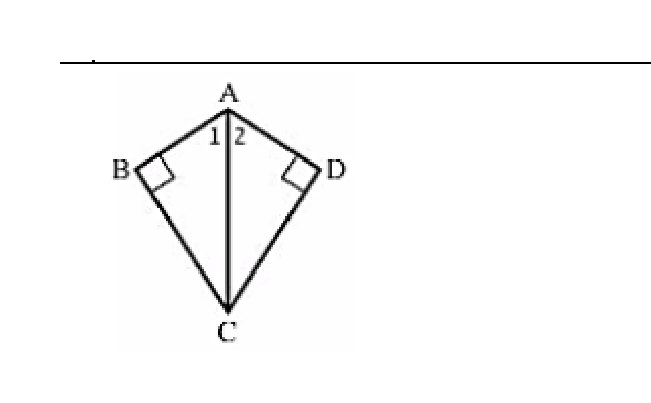
Given:
(AC bisects angle A, and the angles at B and D are right angles)
∠A₁ = ∠A₂
AB ⊥ BC
AD ⊥ DC
(AC bisects angle A, and the angles at B and D are right angles)
a. Prove: ΔABC ≅ ΔADC
Step 1: Identifying the right angles
From the given AB ⊥ BC and AD ⊥ DC, what are the angle values?
∠ABC =
°
∠ADC =
°
Correct! Both angles are 90°
Step 2: Identifying the common hypotenuse
Both triangles are right triangles. What is the common hypotenuse?
Common hypotenuse:
Correct! AC is the common hypotenuse
Step 3: Identifying the equal acute angle
From the given ∠A₁ = ∠A₂, what are the equal angles in the triangles?
∠BAC = ∠
Correct! ∠BAC = ∠DAC (or ∠CAD)
Step 4: Choosing the congruence theorem
We have right triangles with a common hypotenuse and an equal acute angle.
What is the appropriate congruence theorem?
Excellent! Hypotenuse-Acute Angle is the correct theorem!
Proof summary:
• ∠ABC = 90° and ∠ADC = 90° (right angles from the given)
• AC is the common hypotenuse in both right triangles
• ∠BAC = ∠DAC (since ∠A₁ = ∠A₂, AC bisects angle A)
Therefore by Hypotenuse-Acute Angle → ΔABC ≅ ΔADC
• ∠ABC = 90° and ∠ADC = 90° (right angles from the given)
• AC is the common hypotenuse in both right triangles
• ∠BAC = ∠DAC (since ∠A₁ = ∠A₂, AC bisects angle A)
Therefore by Hypotenuse-Acute Angle → ΔABC ≅ ΔADC
b. Prove: AB = AD
b
From the congruence we proved, is it true that AB = AD?
In congruent triangles, corresponding sides are equal.
From the congruence ΔABC ≅ ΔADC, does AB correspond to AD?
Correct! AB = AD because they are corresponding sides in congruent triangles!
From the congruence ΔABC ≅ ΔADC:
The correspondence is: A↔A, B↔D, C↔C
Therefore the corresponding sides are:
• AB = AD (first sides)
• BC = DC (second sides)
• AC = AC (third sides - shared)
Conclusion: AB = AD
The correspondence is: A↔A, B↔D, C↔C
Therefore the corresponding sides are:
• AB = AD (first sides)
• BC = DC (second sides)
• AC = AC (third sides - shared)
Conclusion: AB = AD
Well done! You finished the question!
You understood how to prove right-triangle congruence and find equal sides!