Envelope of a One-Parameter Family
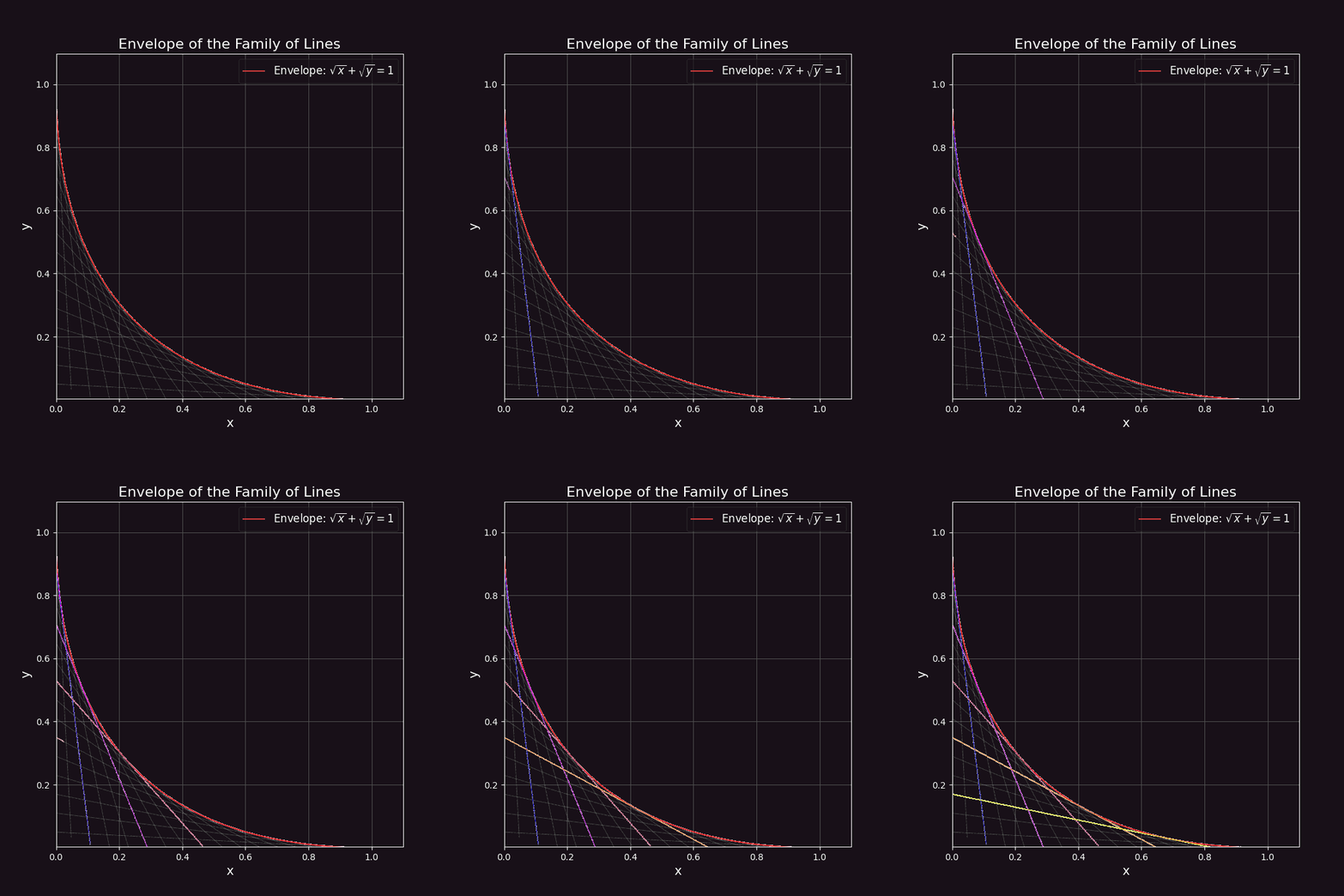
A family of lines and its envelope
For the lines
\( \dfrac{x}{c} + \dfrac{y}{1-c} = 1, \qquad 0 < c < 1, \)
solving \( \varphi=0 \) together with \( \partial\varphi/\partial c=0 \) gives \( x=c^{2},\; y=(1-c)^{2} \):
\( \sqrt{x} + \sqrt{y} = 1. \)
The envelope is tangent to every line of the family — the picture is classic string art.
The astroid
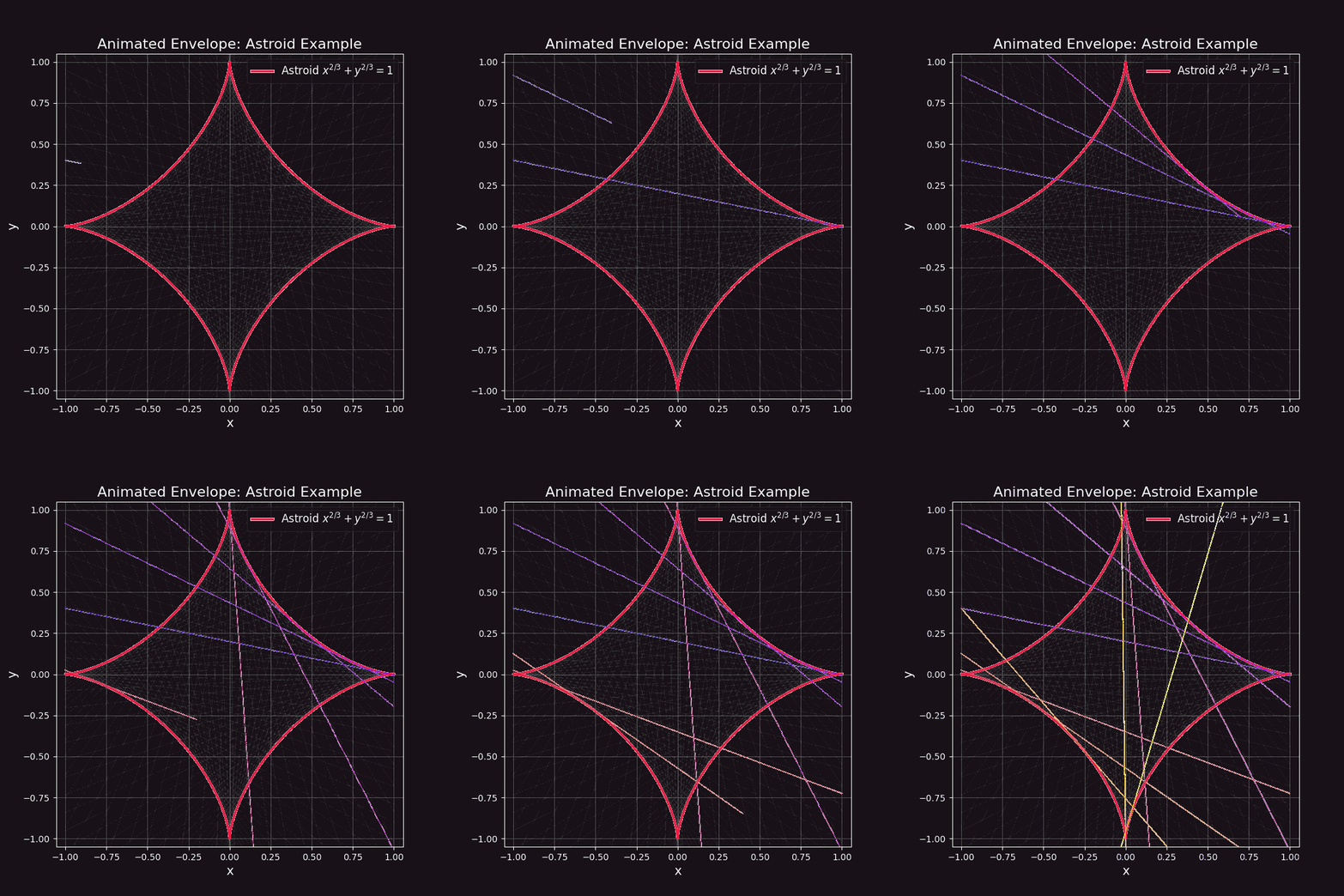
For unit segments sliding with their ends on the axes,
\( \dfrac{x}{\cos\alpha} + \dfrac{y}{\sin\alpha} = 1, \)
the same procedure yields \( x=\cos^{3}\alpha,\; y=\sin^{3}\alpha \) — the astroid \( x^{2/3}+y^{2/3}=1 \).